Can Muslims market their businesses without compromising Islamic values?
It's a question many Muslim entrepreneurs ask. In a world where marketing is often associated with manipulation, exaggerated claims, and aggressive sales tactics, it can be difficult to know where the line is between effective promotion and practices that conflict with Islamic principles.
The good news is that marketing itself is not haram. In fact, when done correctly, marketing can be a means of serving people, creating value, and growing a business in a way that is both ethical and beneficial.
This is where halal marketing comes in.
Halal marketing is the practice of promoting products and services through honest, transparent, and ethical methods that align with Islamic values. It focuses on trust, integrity, fairness, and genuine customer benefit rather than deception, pressure, or manipulation.
Whether you're a freelancer, agency owner, e-commerce seller, coach, consultant, or business owner, this guide will help you market with confidence, integrity, and barakah.
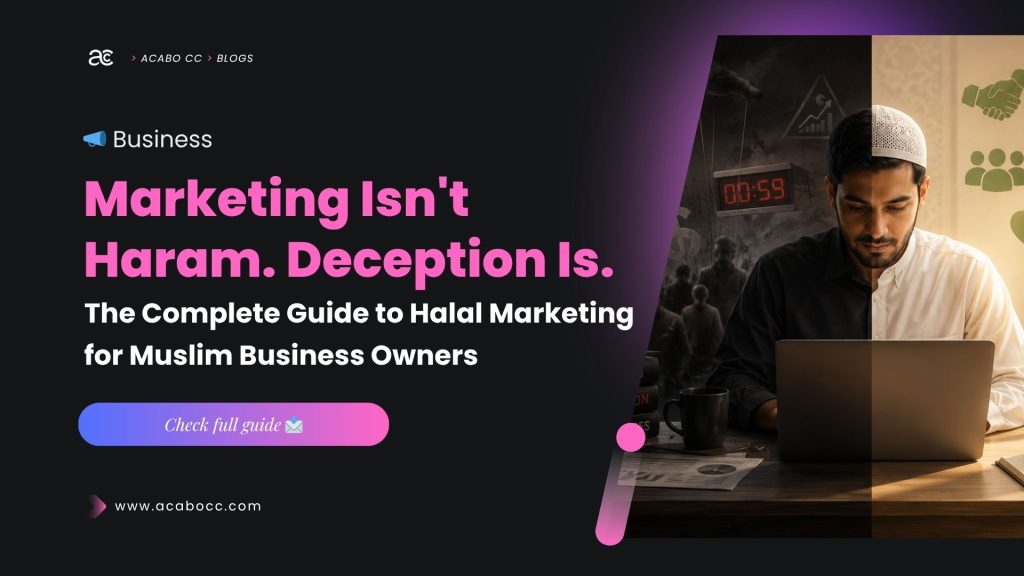
1. What Is Halal Marketing? (The Simple Definition)
Think of halal marketing like halal food. It's not just about what's in it. It's about how it was prepared.
Just like halal food follows specific standards from farm to table, halal marketing follows ethical standards from strategy to execution.
Here's a clean definition: Halal marketing is the practice of promoting your products or services in a way that is honest, ethical, and fully aligned with Islamic principles.
It covers everything — the words you use, the visuals you show, the claims you make, the platforms you use, and the intentions behind your campaigns.
It's not a limitation. It's actually a superpower.
Here's why: in a digital world full of clickbait, fake urgency, and misleading ads, a brand that markets with integrity stands out immediately. Trust becomes your biggest competitive advantage.
| 💡 Quick Distinction Halal marketing ≠ marketing only to Muslims. Halal marketing is about HOW you market not just WHO you market to. A non-Muslim business can practice halal marketing. A Muslim-owned business can unknowingly do haram marketing. |
2. The Core Principles of Halal Marketing
Halal marketing is built on five pillars. Think of them as your compass — not rules that restrict you, but values that direct you.
Principle 1 — Truthfulness (Sidq)
Every claim you make must be honest. No exaggeration. No fake before-and-after photos. No "guaranteed" results you can't back up.
The Prophet (ﷺ) said: "The merchant who is honest and trustworthy will be with the prophets, the truthful, and the martyrs." (Tirmidhi)
In marketing terms: your ad copy, landing pages, testimonials, and product descriptions must reflect reality.
Principle 2 — Transparency (Wuduh)
Hidden fees. Buried disclaimers. Misleading pricing. All of these are off the table.
Halal marketing means being upfront about your pricing, your process, your limitations, and your terms.
Paradoxically, transparency builds more trust than hype. And trust is what converts followers into clients.
Principle 3 — Respect for the Audience
Your audience is not a target to be manipulated. They're human beings who deserve dignity.
This means: no predatory urgency tactics, no exploiting insecurities, no manipulative emotional triggers, and no content that demeans or objectifies.
In halal marketing, ethical persuasion is allowed — presenting real value, sharing genuine stories, making a clear offer. What's haram is manipulation.
Principle 4 — Purity of Product & Service (Tayyib)
You can't market a haram product and call it halal marketing. The offer itself must be permissible.
This rules out marketing for alcohol, gambling, riba-based finance, adult content, or anything clearly haram.
But it also means your business model matters. Are the practices behind your product ethical? Are your suppliers honest? Is your pricing fair?
Principle 5 — Intentionality (Niyyah)
Why are you marketing? To serve people or just to extract money from them?
Your intention shapes everything. A halal marketer wants their product to genuinely benefit the customer. That purpose should come through in every campaign.
And here's the bonus, when your niyyah is right, your marketing actually resonates more because people can feel authenticity.
3. What Makes Marketing Haram? (The Red Lines)
Knowing the boundaries is just as important as knowing the principles. Here are the marketing practices that cross into haram territory:
- False advertising — claiming benefits your product doesn't have
- Artificial scarcity — "Only 2 left!" when you have 200 in stock
- Misleading testimonials — fake reviews or paid endorsements presented as organic
- Exploiting emotions — using fear, shame, or grief to force a decision
- Inappropriate content — sexualized imagery, immodest visuals, or degrading humor
- Promoting haram products — alcohol, gambling, riba, adult services, etc.
- Deceptive pricing — hidden fees, confusing bundles, bait-and-switch tactics
- Spamming — sending unsolicited messages without proper consent
This might sound like a long list but honestly, most ethical marketers avoid these anyway. The difference is that for halal marketers, avoiding them isn't just good business strategy. It's an act of ibadah.
4. Halal Marketing vs. Conventional Marketing
Let's put them side by side. This is where it gets interesting.
| ⚡ Conventional Marketing | ✅ Halal Marketing |
| Driven by ROI first, ethics second | Driven by purpose first, ROI follows |
| Manipulation is an accepted tool | Persuasion must be honest and value-based |
| Urgency is often manufactured | Urgency must be real and truthful |
| Privacy boundaries are flexible | Privacy and consent are non-negotiable |
| Success = sales numbers only | Success = impact + revenue + integrity |
| Content can be risqué if it converts | Content must be modest and dignified |
| Audience = a segment to target | Audience = people to serve and respect |
Notice something?
Halal marketing isn't weaker than conventional marketing. In many ways, it's smarter.
Brands built on trust last longer. Customers who feel respected become loyal advocates. Word-of-mouth in Muslim communities is incredibly powerful, and it only happens when you've earned real trust.
5. How Halal Marketing Works Across Digital Channels
Halal marketing isn't confined to pamphlets at the masjid. It applies across every digital channel you're already using.
Social Media
Platforms like Facebook, Instagram, and TikTok are all fair game as long as your content is honest, modest, and serves your audience.
- Don't use clickbait headlines that mislead
- Avoid using provocative or immodest imagery to grab attention
- Engage genuinely, respond to comments, share real behind-the-scenes
- Use storytelling that highlights real customer impact
Paid Advertising (Facebook Ads, Google Ads, TikTok Ads)
Running paid ads is halal. What matters is the content of the ad and the product being promoted.
- Ad copy must be truthful. No fake urgency, no exaggerated claims.
- Target ethically. Don't exploit vulnerable demographics.
- Your landing page must match your ad. No bait-and-switch.
- Retargeting is fine as long as you comply with privacy laws and platform terms.
Email Marketing
Email is one of the most powerful, and most misused, channels in marketing.
- Only email people who have explicitly opted in
- Every email must provide real value, not just a sales pitch
- Always include an easy unsubscribe option
- Don't use deceptive subject lines to boost open rates
SEO & Content Marketing
This is arguably the most naturally halal channel because great content genuinely helps people.
- Write to serve your reader first, rank second
- Don't stuff keywords unnaturally that's a form of deception toward search engines
- Build backlinks through genuine relationships and valuable content
- Share your real expertise not AI-generated fluff with no substance
CRM & Marketing Automation
Automating your follow-ups and client nurturing is completely halal, it's just efficiency.
- Build sequences that educate and help, not just push for a sale
- Personalize based on real data not guesses or assumptions
- Respect unsubscribes immediately
- Don't create fake scarcity in automated sequences
6. Real Examples of Halal Marketing in Action
Still abstract? Here's what halal marketing actually looks like in the real world.
| 📦 Example 1 — Halal Food Brand Instead of saying "Best halal food in the city! Guaranteed you'll love it or your money back!" (vague and pressuring), a halal marketer would say: "Our chicken is certified halal by [body], sourced from [farm], prepared fresh daily. Here's what our customers say." — Specific. Honest. Transparent. |
| 💻 Example 2 — Muslim-Owned Digital Agency Rather than running ads that say "Stop wasting money! 10x your ROI in 30 days or we'll refund you!" (pressure + unverifiable claim), a halal agency says: "We help halal brands grow online through ethical advertising and honest strategy. Here are 3 results from our clients this quarter." — No hype. Just proof. |
| 🏪 Example 3 — Muslim Fashion Brand Instead of using trending audio or borderline-immodest styling to get TikTok views, a halal marketer creates content around the story of the brand, the values behind modest fashion, and real customers sharing their experience. The content is compelling AND dignified. |
7. How to Start Your Halal Marketing Strategy
Ready to build a marketing strategy you can be proud of? Here's where to start.
- Audit your current marketing. Go through your existing ads, social posts, and email sequences. Are there any claims that are exaggerated? Any tactics that feel manipulative? Fix those first.
- Define your niyyah. Write down why you're marketing. Not just "to make money" — but the real impact you want to have on your customers' lives. Keep this visible.
- Choose the right channels. Start with 1-2 channels where your audience actually is. For most Muslim business owners in the Philippines, that's Facebook + email. Master those before expanding.
- Create content that genuinely helps. Answer real questions your customers are asking. Share real results. Show real processes. The more transparent you are, the more people trust you.
- Build a system, not just campaigns. One-off posts don't build a brand. You need a content calendar, an email sequence, and a follow-up system that works consistently — without burning you out.
- Get professional help if you need it. Halal marketing is a skill. If you'd rather focus on running your business, working with a halal marketing agency means your growth strategy is in the right hands.
Key Takeaways
- Halal marketing is about HOW you market — not just WHO you market to
- It's built on 5 principles: truthfulness, transparency, respect, purity of product, and intention
- Common haram marketing practices include fake urgency, misleading claims, and manipulative tactics
- Halal marketing works across ALL digital channels — ads, social, email, SEO, automation
- Brands built on trust outperform brands built on hype — in the long run
- Your niyyah matters: serve your customer first, and revenue will follow
| 🚀 Ready to Build a Halal Marketing Strategy for Your Business? At Acabo CC, we help Muslim-owned brands grow online — with ads, content, automation, and web strategies that are effective AND ethical. Whether you're just starting out or ready to scale, we'd love to help you build something you're proud of. Learn more about partnering with us or book a free strategy call. |
About the Author